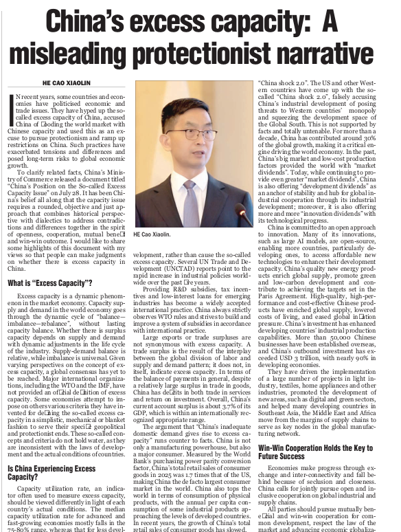
| Ambassador Cao Xiaolin’s Article on Qatar Tribune :“China’s Excess Capacity”: A Misleading Protectionist Narrative |
| 2026-08-26 03:54 |
|
On August 24, Ambassador Cao Xiaolin published an article on Tribune titled “China’s Excess Capacity”: A Misleading Protectionist Narrative. Below is the full text. In recent years, some countries and economies have politicized economic and trade issues. They have hyped up the so-called excess capacity of China, accused China of flooding the world market with Chinese capacity and used this as an excuse to pursue protectionism and ramp up restrictions on China. Such practices have exacerbated tensions and differences and posed long-term risks to global economic growth. To clarify related facts, China’s Ministry of Commerce released a document titled “China’s Position on the So-called Excess Capacity Issue” on July 28. It has been China’s belief all along that the capacity issue requires a rounded, objective and just approach that combines historical perspective with dialectics to address contradictions and differences together in the spirit of openness, cooperation, mutual benefit and win-win outcome. I would like to share some highlights of this document with my views so that people can make judgments on whether there is excess capacity in China. What is “Excess Capacity”? Excess capacity is a dynamic phenomenon in the market economy. Capacity supply and demand in the world economy goes through the dynamic cycle of “balance—imbalance—rebalance”, without lasting capacity balance. Whether there is surplus capacity depends on supply and demand with dynamic adjustments in the life cycle of the industry. Supply-demand balance is relative, while imbalance is universal. Given varying perspectives on the concept of excess capacity, a global consensus has yet to be reached. Major international organizations, including the WTO and the IMF, have not provided an official definition of excess capacity. Some economies attempt to impose on others various criteria they have invented for defining the so-called excess capacity in a simplistic, mechanical or blanket fashion to serve their specific geopolitical and protectionist ends. These so-called concepts and criteria do not hold water, as they are inconsistent with the laws of development and the actual conditions of countries. Is China Experiencing Excess Capacity? Capacity utilization rate, an indicator often used to measure excess capacity, should be viewed differently in light of each country’s actual conditions. The median capacity utilization rate for advanced and fast-growing economies mostly falls in the 75-80% range, whereas that for less developed countries usually stands between 50% and 64%. In light of China’s development realities, the utilization rate of industrial production capacity kept within a reasonable range. In 2025, the capacity utilization rate of industrial enterprises above the designated size was 74.4%, and higher capacity utilization was observed in high-tech manufacturing, high-end equipment manufacturing and strategic emerging industries. There is no necessary connection between industrial subsidies and excess capacity. Sound industrial subsidy policies help correct market failures, advance technology innovation, protect environment, reduce poverty, and promote balanced development, rather than cause the so-called excess capacity. Several UN Trade and Development (UNCTAD) reports point to the rapid increase in industrial policies worldwide over the past five years. Providing R&D subsidies, tax incentives and low-interest loans for emerging industries has become a widely accepted international practice. China always strictly observes WTO rules and strives to build and improve a system of subsidies in accordance with international practice. Large exports or trade surpluses are not synonymous with excess capacity. A trade surplus is the result of the interplay between the global division of labor and supply and demand pattern; it does not, in itself, indicate excess capacity. In terms of the balance of payments in general, despite a relatively large surplus in trade in goods, China has deficits in both trade in services and return on investment. Overall, China’s current account surplus is about 3.7% of its GDP, which is within an internationally recognized appropriate range. The argument that “China’s inadequate domestic demand gives rise to excess capacity” runs counter to facts. China is not only a manufacturing powerhouse, but also a major consumer. Measured by the World Bank’s purchasing power parity conversion factor, China’s total retail sales of consumer goods in 2025 was 1.7 times that of the U.S., making China the de facto largest consumer market in the world. China also tops the world in terms of consumption of physical products, with the annual per capita consumption of some industrial products approaching the levels of developed countries. In recent years, the growth of China’s total retail sales of consumer goods has slowed. This aligns with the country’s economic transition from high-speed growth to a phase of high-quality development. It also mirrors an ongoing structural upgrade in China’s consumption. It is both unobjective and biased to view China’s slowdown in retail sales growth as a sign of inadequate domestic demand. The argument that “China’s inadequate domestic demand gives rise to excess capacity” simply distorts concepts. What Does China’s Industrial Modernization Mean for the World? China’s industrial modernization is “China opportunity 2.0” to the world, not “China shock 2.0”. The U.S. and other Western countries have come up with the so-called “China shock 2.0”, falsely accusing China’s industrial development of posing threats to Western countries’ monopoly and squeezing the development space of the Global South. This is not supported by facts and totally untenable. For more than a decade, China has contributed around 30% of the global growth, making it a critical engine driving the world economy. In the past, China’s big market and low-cost production factors provided the world with “market dividends”. Today, while continuing to provide even greater “market dividends”, China is also offering “development dividends” as an anchor of stability and hub for global industrial cooperation through its industrial development; moreover, it is also offering more and more “innovation dividends” with its technological progress. China is committed to an open approach to innovation. Many of its innovations, such as large AI models, are open-source, enabling more countries, particularly developing ones, to access affordable new technologies to enhance their development capacity. China’s quality new energy products enrich global supply, promote green and low-carbon development and contribute to achieving the targets set in the Paris Agreement. High-quality, high-performance and cost-effective Chinese products have enriched global supply, lowered costs of living, and eased global inflation pressure. China’s investment has enhanced developing countries’ industrial production capabilities. More than 50,000 Chinese businesses have been established overseas, and China’s outbound investment has exceeded USD 3 trillion, with nearly 90% in developing economies. They have driven the implementation of a large number of projects in light industry, textiles, home appliances and other industries, promoted the development of new areas, such as digital and green sectors, and helped many developing countries in Southeast Asia, the Middle East and Africa move from the margins of supply chains to serve as key nodes in the global manufacturing network. Win-Win Cooperation Holds the Key to Future Success Economies make progress through exchange and inter-connectivity and fall behind because of seclusion and closeness. China calls for jointly pursue open and inclusive cooperation on global industrial and supply chains. All parties should pursue mutually beneficial and win-win cooperation for common development, respect the law of the market and advancing economic globalization, strengthen coordination of industrial policies, expand market openness, jointly create cooperation opportunities and uphold multilateralism. China and the GCC countries are all important participants in economic globalization and the multilateral trading system. China stands ready to work with our GCC partners to build a more just and equitable international economic order and foster an open and inclusive global framework for cooperation across industrial and supply chains. |